
My Wastewater Service
OMWD provides wastewater (sewer) collection and treatment services to 4S Ranch, Rancho Cielo and portions of the City of San Diego (Santaluz, Black Mountain Ranch, Heritage Bluffs, and Avion).
Wastewater service for other OMWD water customers may be provided by City of Encinitas, City of San Diego, City of Solana Beach, Leucadia Wastewater District, Fairbanks Ranch Community Services District, Rancho Santa Fe CSD, or Whispering Palms CSD. Search for your address in our interactive map to determine your wastewater agency.
Many agencies providing wastewater (sewer) service, including OMWD, calculate wastewater service bills based in part on water consumption at the property. Therefore, higher water consumption can lead to higher wastewater service bills.
Wastewater service charges are collected on each property owner’s tax bill on an annual basis. Payment is due at the same time that tax bills are due to the San Diego County Tax Assessor’s Office.
For those customers whose water and wastewater service needs are served by different agencies, water usage data may be exchanged between agencies. For example:
- For customers who receive a wastewater service bill from OMWD and a water bill from the City of San Diego, the City provides water usage data to OMWD.
- For customers who receive a wastewater service from the City of San Diego and a water bill from OMWD, OMWD provides monthly water usage data to the City. The City bases the wastewater service charge on winter usage. If a customer’s water usage is higher this winter than it was in the previous year, the wastewater service bill may also be higher. For questions about how the City calculates wastewater service bills, visit the City’s website.
Each parcel receives one wastewater assessment on the property tax bill, even if it has multiple water meter accounts. Irrigation or fire meters are not included in any calculations.
Visit our Billing and Fees page for current wastewater rates and charges.
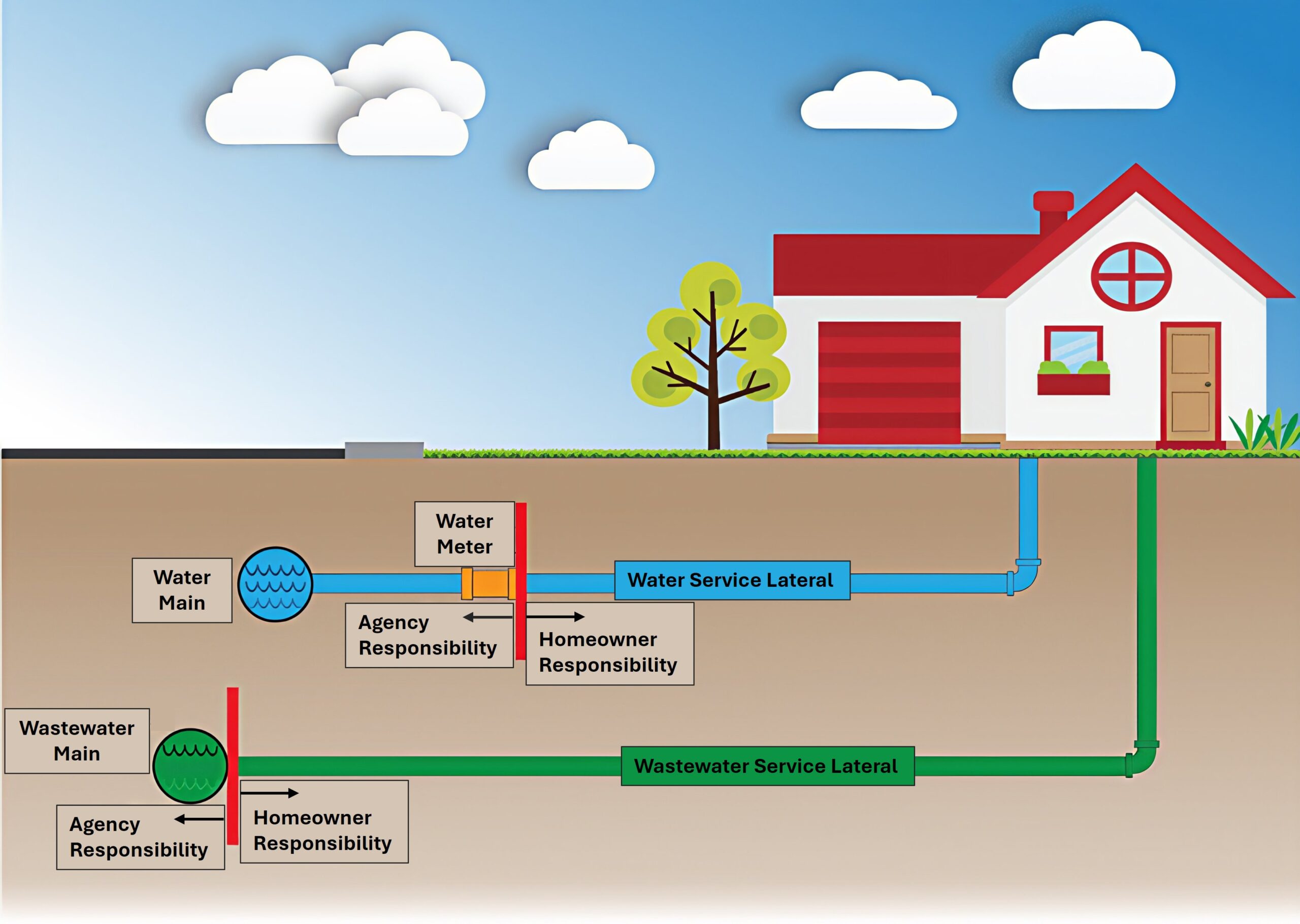
The service lateral is the underground pipe connecting our wastewater main to your property’s plumbing system. Customers are responsible for maintaining and repairing the private portion of their wastewater service lateral from the point of connection to the main [Administrative and Ethics Code § 28.13(f)]. If OMWD does not provide your wastewater service, contact your wastewater provider.
Prevent Backups by Keeping Non-Flushable Items out of the Toilet
When toilets are misused as trashcans, unfortunate consequences can occur including backups in your plumbing or problems at your local reclamation facility. To prevent these problems from occurring, avoid flushing items such as baby wipes and diapers, rags and towels, cotton swabs, candy and food wrappers, clothing labels, sponges, toys, plastic items, aquarium gravel, kitty litter, latex gloves, cigarette butts, sanitary napkins, hair, or “disposable” toilet brushes.
In addition, whatever ends up in your toilet can potentially have an impact on the water environment in your community, so it is critical to keep household wastes such as chemicals and pharmaceutical products out of your toilet. US Food and Drug Administration provides information on where and how to dispose of unused medicines.
Fats, oils, and grease (or FOG) poured down a drain can clog municipal sewer pipes creating blockages that lead to backups and spills. This common practice could be doing damage to your own internal plumbing at your house or on your property.
To prevent damage to your pipes, flooding in your home, and problems at your local wastewater plant:
- Scrape grease material and food scraps from all cookware and dishware into a can or the trash for disposal.
- Use strainers in sink drains to catch food scraps and other solids, and empty the drain strainers into the trash for disposal.
- Don’t put grease or greasy food in your home garbage disposal. These units only shred solid material into smaller pieces and do not prevent grease from going down the drain.
- Wipe cookware and dishware prior to washing. Don’t rely on commercial additives in detergents to dissolve grease—they may just pass it down the line and cause problems in other areas.
- Commercial kitchens should follow FOG best management practices.
View our FOG facts overview, including for more information.
4S Ranch began taking shape in the 1980s. In order to serve the sanitation needs of this community, the County of San Diego built a small wastewater treatment plant. In 1998, OMWD annexed the sanitation district from the County, and began collecting and treating wastewater for the 4S Ranch and Rancho Cielo communities.
Additionally, OMWD expanded and modernized the wastewater treatment plant in order to treat the additional wastewater flows from further development in these communities. The 4S Ranch Water Reclamation Facility now incorporates “tertiary” treatment and disinfection processes, transforming the wastewater into high-quality recycled water for irrigation.