

My Water Service
Understanding the water service to your home or business is the best way to save money, conserve water, and prevent costly damage.
Learn more below about your water meter, water pressure, how to identify leaks, and how to protect yourself by setting alerts about your usage.
My Water Use gives you easy access to timely information about your water usage and allows you to set billing and leak alerts.
-
-
-
-
- Receive an estimate of your bill at any time during the billing cycle.
- Get notified if your bill is projected to exceed a specified dollar amount.
- Be alerted of potential leaks based on your water usage. Leak alerts can not only save you money, but they can help prevent costly property damage.
-
-
-
Frequently Asked Questions
Log into your OMWD customer account account or enroll.
Already signed up for online bill pay? Use your existing username and password to log in.
To enroll, use the account number listed on your water bill.
Note: Once enrolled, it will take 24 hours for your water use data to appear.
Once logged in, select “View Bill and Usage,” and then select “View Usage.”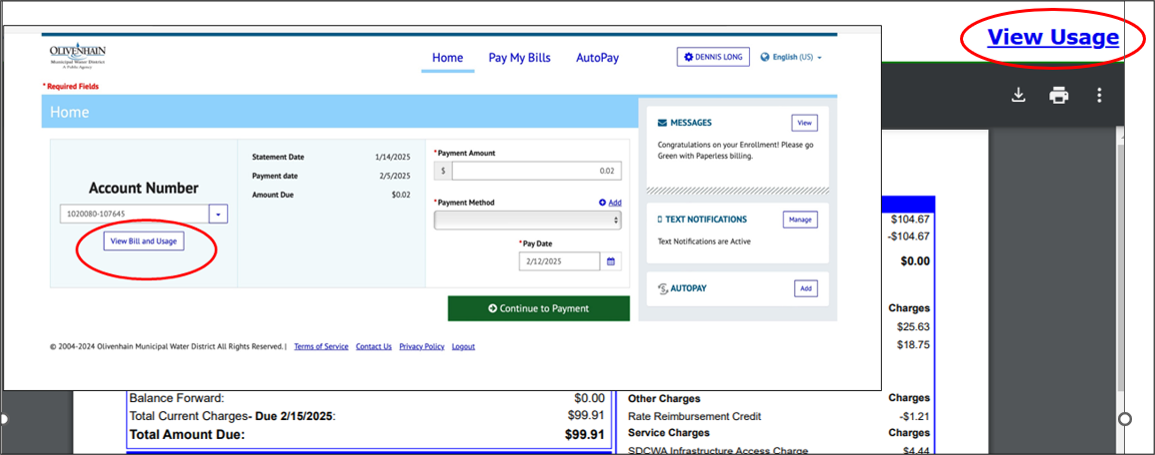
Watch the short tutorial video below or use our step-by-step guide that will walk you through how to access your account, personalize your settings, measure your water use, and set up thresholds to be alerted to abnormal use.
Alerts can be added by clicking on “My Thresholds” and entering the desired notification settings. You will be alerted if your usage exceeds the threshold you set (billing and/or leak). You specify how you prefer to be contacted: email, text, or phone.
Set a water bill threshold
Receive an alert when your water usage exceeds a certain dollar amount each month. It also can alert you in advance if your estimated bill is expected to exceed the dollar amount that you set. Set your billing dollar amount for what you normally pay in a month.
In the example below, the customer wants to be notified both when their bill exceeds $500 at any time during the billing period (“Current”) and if they are on track to exceed $500 at the end of the billing period (“Projected”).
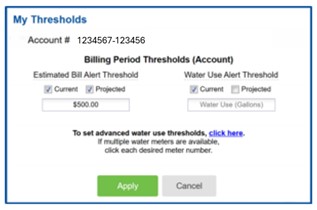
You can set a preferred water use limit, say for a month, and receive alerts if your usage exceeds that amount.
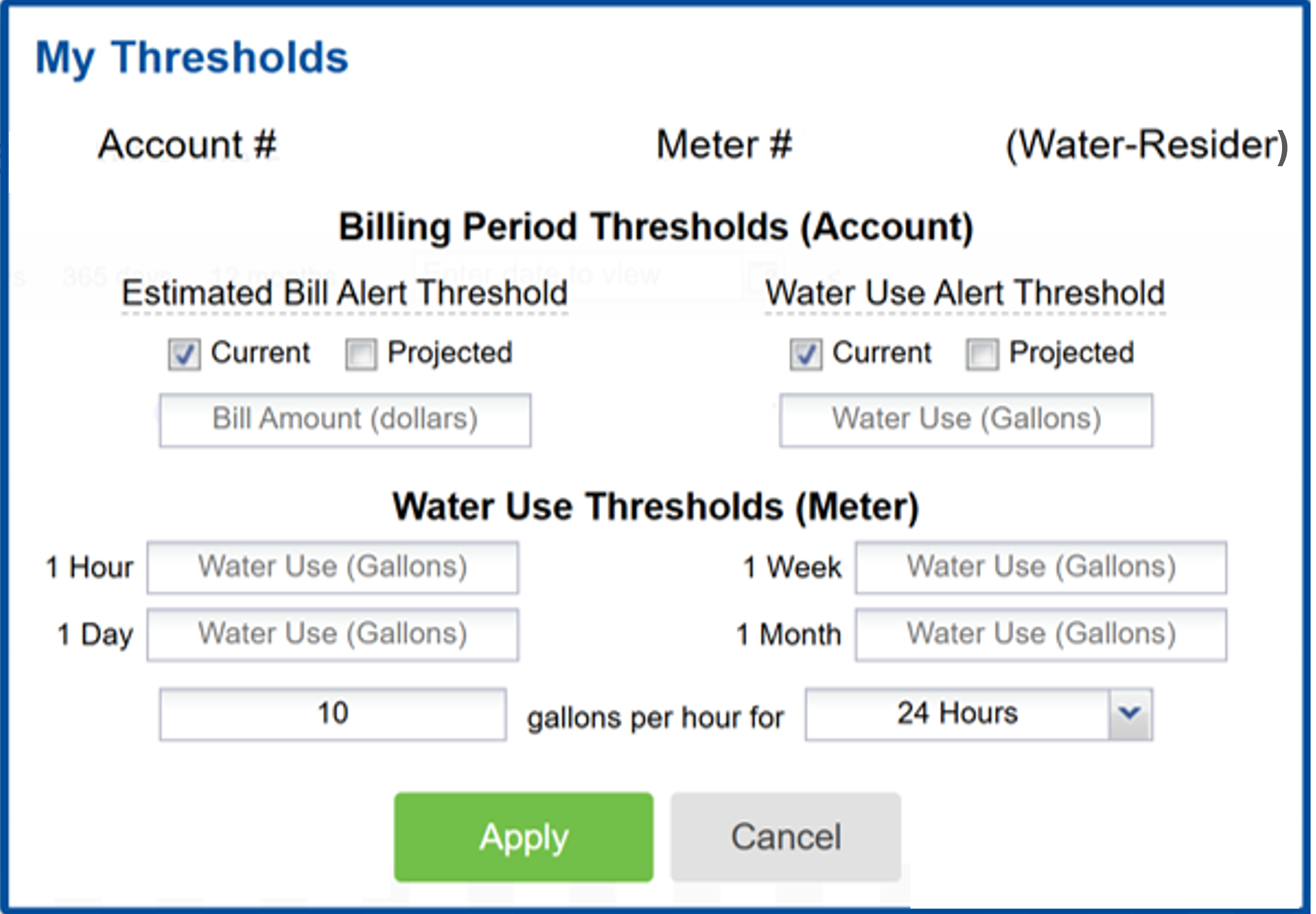
The example below will detect continuous water flow through your meter, which can indicate a leak. See how the leak alert works, then you can adjust and set up other alerts.
Setting low thresholds can result in more alerts than you might want, but you can always log back in to increase your thresholds.
Any alerts set on your old meter will need to be reestablished on the new meter. Alerts set for the billing period, such as by dollar amount, do not require any changes. Your old meter will still appear in your OMWD account and will deactivate after several weeks. Please note that the “Estimated Bill” feature may give a higher than anticipated figure, as the estimate may include both meters until the old meter changes to inactive. Rest assured, your bill statement will only charge you for the correct number of meters you have.
Email Customer Service or call us at 760-753-6466.
Most water meters are located near the street in a concrete meter box with the lid at ground level. You can lift the water meter cover with a long-handled screwdriver, but please be careful to not damage any wires located in the meter box.
You may find several meters grouped together. To verify the meter you are looking at is your own, compare the meter number found on your bill to the identification number on the meter dial.
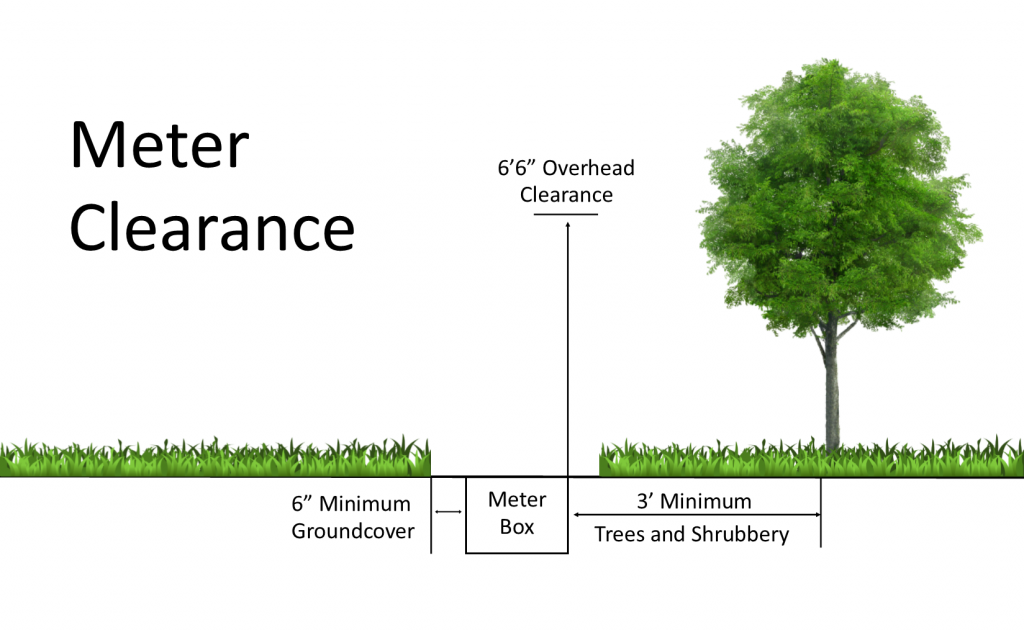
The meter box should be kept clear of debris, vegetation, roots, excess dirt, and vehicles to ensure easy access for meter reading and in the event of a water emergency.
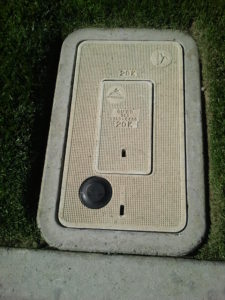
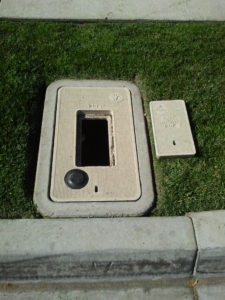
To access your meter(s), you will first need to remove the center lid. A flathead screwdriver inserted into the small hole can be used to lift the lid. Set the lid down to the right side of the meter box. Use a flashlight to check for bees, spiders, snakes, and other potential threats.
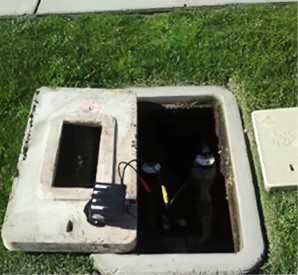
The meter cover can then be removed by donning a pair of gloves, then grasping the inside of the open center area and raising the cover so it is upside down. Set the cover down gently to prevent disconnecting or damaging the radio read wires.
The images below show a meter box with a domestic and fire meter inside. Not all customers have a dedicated fire meter; many will only have a domestic meter in their meter box.
You may find several meters grouped together. To verify the meter you are looking at is your own, compare the meter number found on your bill to the identification number on the meter dial.
The meter box should be kept clear of debris, vegetation, roots, excess dirt, and vehicles to ensure easy access for meter reading and in the event of a water emergency.
For assistance in locating your meter, contact us at 760-753-6466.
Your meter has a valve that you can use to shut off the water to your property. Turn the handle perpendicular to the pipe to turn the water off. To turn the water on, slowly move the handle back into the position parallel to the pipe. Doing this slowly will avoid water hammer (a pressure wave that results in a knocking noise, vibration, and potentially pipe damage). Occasionally move the valve to the off and on positions to ensure it works when you need it to.
If you are unable to move the handle, please notify us by calling 760-753-6466 or emailing Customer Service.
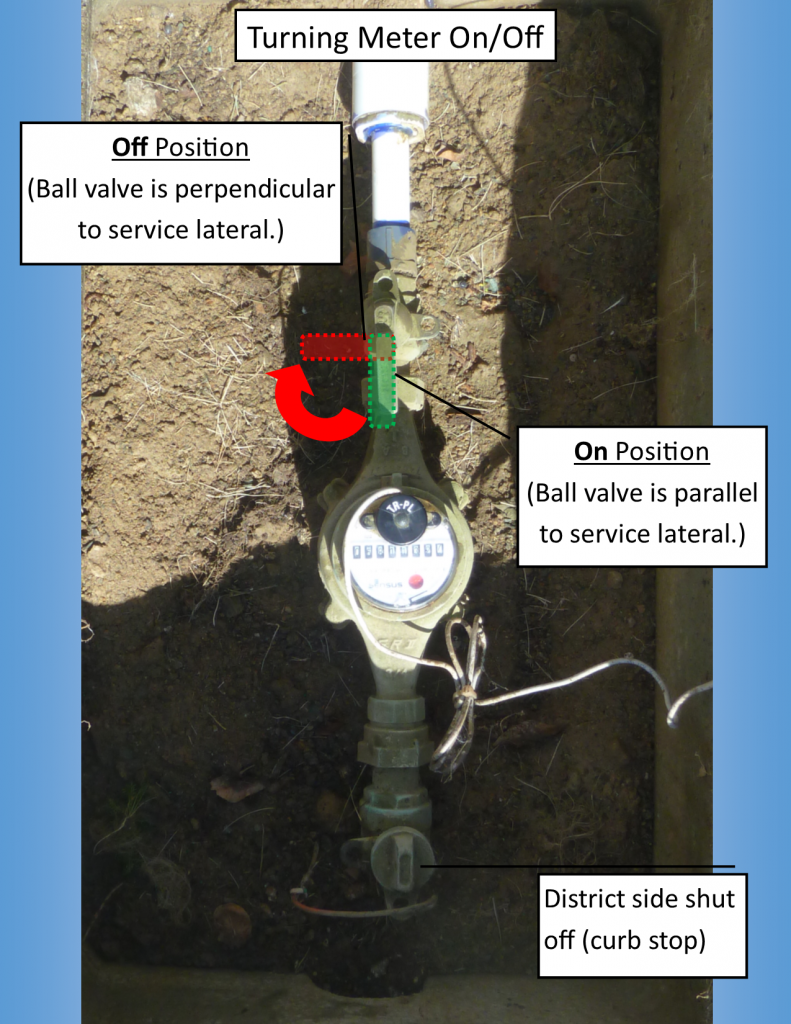
Your water use is measured by a meter that meets accuracy standards set by American Water Works Association. Meters in OMWD’s service area are read and billed monthly, utilizing Advanced Metering Infrastructure. This means your meters are read remotely and regularly, even if you don’t see OMWD driving through your neighborhood.
The first four digits displayed on the left face of the meter are used for billing. For example, a reading of 013896514 appears as 0138 on your bill. The difference between the current and previous readings is your consumption for that period. Each billing unit equals one hundred cubic foot (HCF), or 748 gallons.
For more information, please view this video demonstration of how meters are read.
View this video to troubleshoot for a leak using your meter.
You can check for a water leak yourself by following the instructions below.
- Open the lid from the meter and write down the current meter reading. Do not turn off the valve off in the meter box. Do not use any water in your home for two to three hours. After the time has elapsed, check the meter reading again.
- If the reading has not changed, you do not have a leak.
- If the reading has changed, you have a leak on your property. Locate your house shut-off valve (typically in the garage or on the side of your home) and shut the water off.
- With the house shut-off valve closed, repeat the same steps above to see if the leak is outside the home, perhaps in the irrigation system.
- If you determine a leak is present, the next step is to find the location of the leak. First, look for evidence of leakage between the meter and your home.
- If no leaks are found, conduct a thorough inspection of your pipes, fixtures, connections, and valves in and under your home.
- For all facilities after the meter, private plumbers or leak detection specialists should be considered. OMWD cannot repair or troubleshoot beyond the meter.
Residential properties should maintain household water pressure no higher than 80 pounds per square inch (psi). Excessive pressure can damage appliances, irrigation systems, and plumbing fixtures. Since pressure regulators can fail within just three years, it’s important to monitor yours.
Pressure within the street water main is often higher to ensure fire flow.
OMWD recommends that customers regularly maintain and replace pressure regulators to avoid damage caused by higher pressure.
The service lateral is the underground pipe connecting OMWD’s water main to your property’s water meter. Customers are responsible for the maintenance of the private portion of their water service lateral that is on the customer’s side of the water meter.
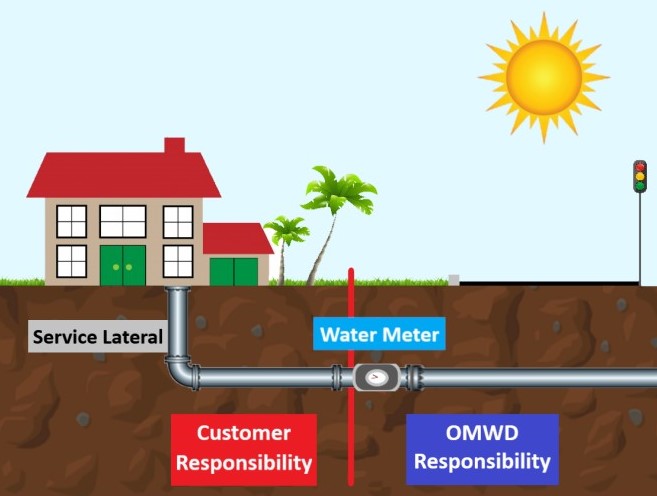
First, check the valve where the water line enters your property to make sure it hasn’t been turned off. Sometimes, a landscaper discovers a leak and turns off the water without notifying the property owner.
Have you recently had your water softener replaced? Sometimes the representative forgets to turn the valve back on. Does it have a restart button that may need to be pushed? Some softeners have bypass valves that try to bypass the unit. Look for obvious leaks between the valve and water meter. If this doesn’t work and you still have no water, call our office at 760-753-6466, and we will be happy to assist you in finding the problem to restore your water service.
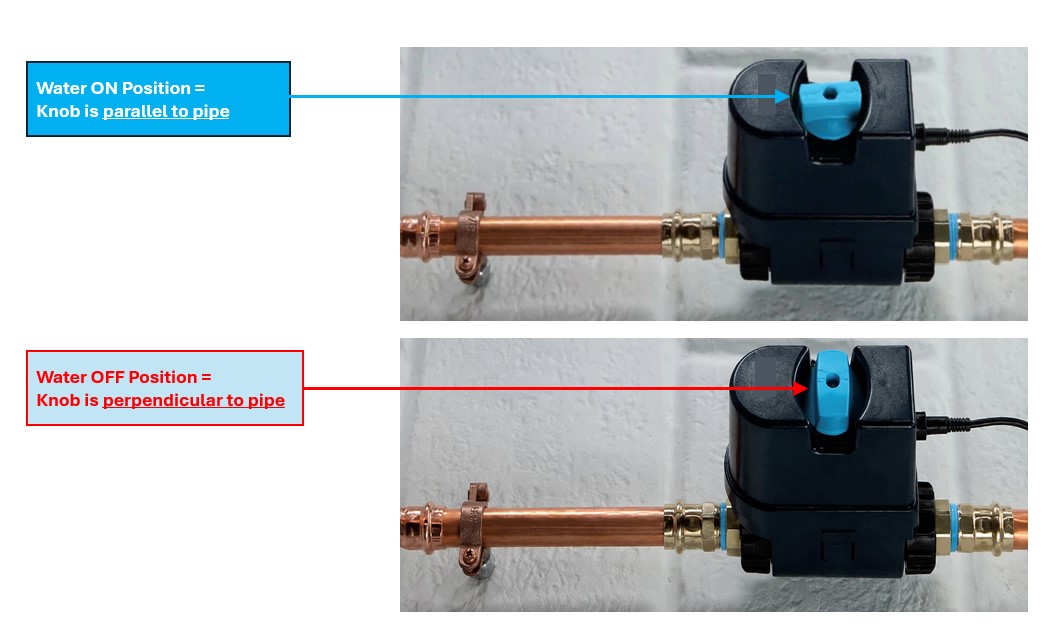
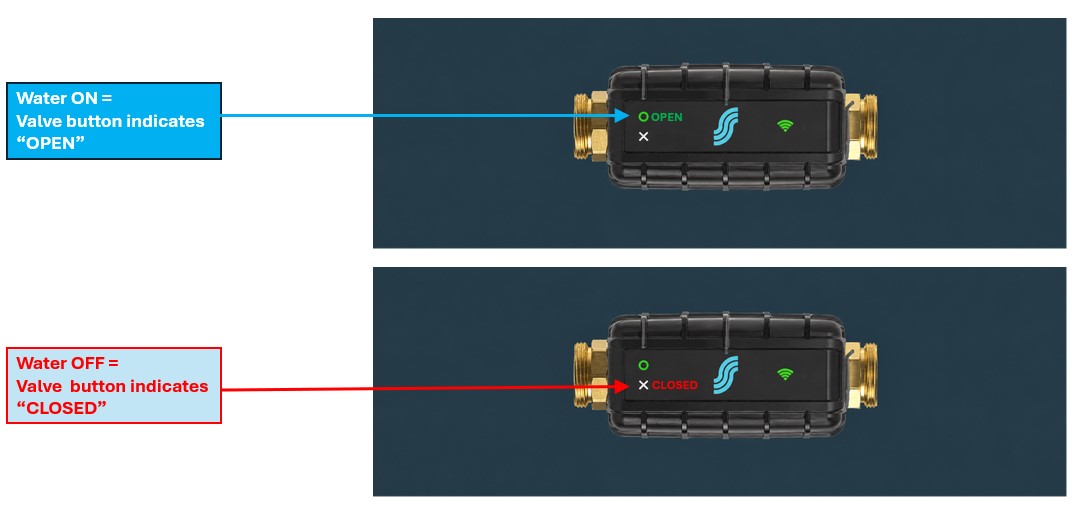
Do you have a smart flow-monitoring device (like Moen Flo or Phyn) installed on your plumbing system? These devices detect unusual or inconsistent water usage and have automatic and remote water shut-off capabilities. Some insurance companies promote and/or require homes to have them. Please check to determine if your water has been turned off by your smart device. To do so, check the device’s phone app, which should be kept up to date with the latest software.
You can also inspect the device itself to see if the knob or the valve position indicator light shows that the valve is closed—see below for examples, or contact your manufacturer if these do not match the device at your property.
You should be able to turn your water back on manually or with your device’s app if there was no legitimate reason for water to be shut off; otherwise, you may need to contact a private plumbing or leak detection service to help you troubleshoot your water leak.
Some properties have a dedicated water meter for a fire protection system, located in the general vicinity of the domestic water meter. While some infrequent water use can be expected due to fires or system testing, any leak discovered in the fire line, must be promptly repaired to ensure your system will protect your home in an emergency. Please call OMWD to address this issue if you are unable to promptly make the repair. You may need to schedule a plumber, leak detection expert, or fire protection system specialist.